Validating a shared geometry boundary
Can exact planar geometry and analytic curved boundaries share a reliable topology model?
An editable CAD system needs more than plausible-looking solids: faces, edges and volumes must remain consistent after operations. My longer-term goal is an original geometry kernel. These experiments progress from planar solids through curved boundaries to a shared topology model, using OCCT as an independent comparison rather than trusting rendered images.
Finding54 OCCT comparisons passed. Maximum volume difference: 2.73 × 10⁻¹² mm³ across the tested cases.
Independent comparison
| Measure | Recorded result |
|---|---|
| Cases passing comparison | 54 / 54 |
| Surface samples | 16,045 |
| Maximum area difference | 6.82 × 10⁻¹³ mm² |
| Maximum volume difference | 2.73 × 10⁻¹² mm³ |
| Maximum sampled surface distance | 4.02 × 10⁻¹⁵ mm |
Research question
I’m building original geometry algorithms alongside a CAD application. The problem here is a shared representation: exact planar geometry and analytic curved surfaces need to agree on vertices, directed edge uses, loops, faces, and connected shells.
Method
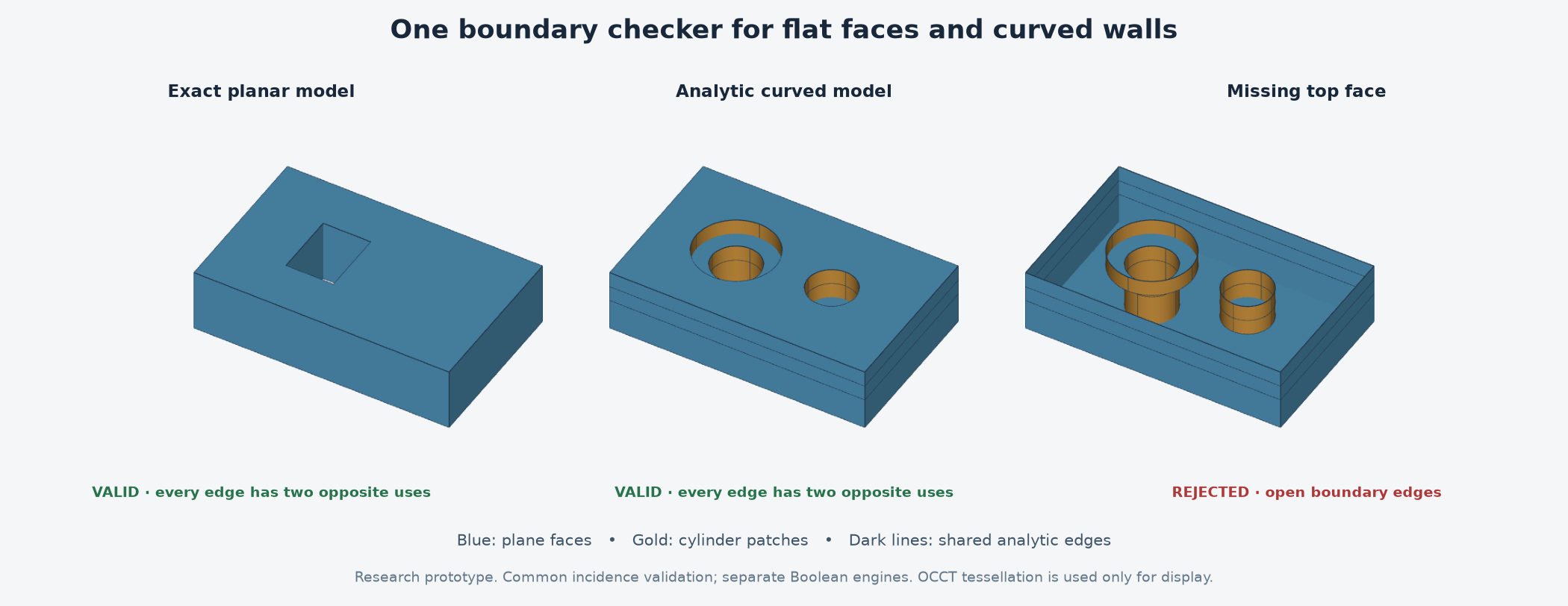
The validator checks loop closure, orientation, opposite edge uses, connected vertex links, and shell topology. Planar rational values remain exact; curved boundaries use an explicit tolerance. I compare converted shapes against OCCT for validity, shell count, area, signed volume, and sampled surface distance.
Result
All 54 recorded comparisons passed. The figure includes an intentionally missing face to show why plausible appearance is insufficient: an open shell must be rejected even if most of the rendered object looks correct. The full per-case results are available below.
Limits of the evidence
Finite surface samples and matching shell counts do not prove global geometric equivalence. Mixed-backend Booleans, general self-intersection detection, shell nesting, and persistent face naming remain open. These results support this bounded representation, not a claim of a production-ready general CAD kernel.