Distilling a textured mesh into Gaussian splats
How faithfully can Gaussian splats reproduce a captured space represented by a textured mesh?
I’m exploring how ordinary room captures could become navigable real-estate walkthroughs for CuseSublets. That involves several different problems: recovering geometry, preserving appearance and making the result useful to a viewer. This study tests appearance representation from a known mesh; separate photo-only and depth-assisted trials investigate the earlier reconstruction step.
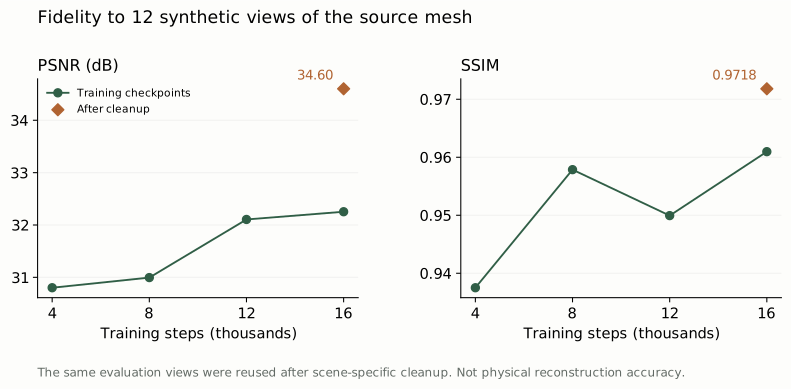
FindingAfter scene-specific cleanup: 34.60 dB PSNR and 0.9718 SSIM on the same 12 synthetic evaluation views.
Training & evaluation
| Measure | Recorded result |
|---|---|
| Training / evaluation views | 576 / 12 |
| Image resolution | 768 × 576 |
| Optimization steps | 16,000 |
| Before cleanup: PSNR / SSIM | 32.25 dB / 0.9610 |
| After cleanup: PSNR / SSIM | 34.60 dB / 0.9718 |
| Unstable splats removed | 1,122 of 1,499,999 |
The larger reconstruction pipeline
Earlier apartment trials compared 48 RGB images processed with predicted depth against 357 RGB-D frames fused with supplied camera poses. Photo-only output recovered recognizable room structure but warped surfaces; depth-assisted output was more coherent. Different inputs and view counts prevent a controlled algorithm comparison. The Gaussian-splat experiment below starts from a textured mesh and asks how well a compact learned representation can reproduce its views. It is one stage toward a walkthrough, not proof that listing photos alone recover measured architecture.
Research question
Property walkthroughs need representations that remain useful as the camera moves. This experiment isolates representation fidelity: starting with a textured apartment mesh, can a trained Gaussian splat reproduce its rendered appearance at other viewpoints? It is mesh-to-splat distillation, not reconstruction from the original camera photographs.
Method
I rendered 576 calibrated images from 48 interior positions, with 12 directions per position. Twelve additional views used different camera positions and directions. Brush trained for 16,000 steps from 300,000 area-weighted surface samples, with a 1.5-million-splat ceiling and SH degree zero for baked, view-independent textures.
Failure analysis & cleanup
The raw result contained colored haze from a small number of exploded Gaussian footprints. Removing splats with a maximum sigma above 0.5 scene units removed 1,122 splats and left 1,498,877. A final evaluation/export pass improved the recorded PSNR from 32.25 to 34.60 dB and SSIM from 0.9610 to 0.9718.
Interpretation
The measurements describe reproduction of this source mesh on these synthetic views. They do not establish physical dimensions, recovery of missing scan detail, or quality against real photographs. The scene-specific threshold was assessed using the same evaluation set, so the cleaned score is not an untouched test-set estimate.
Next experiment
The next useful comparison is a fresh set of withheld camera paths, with quality assessed along the walkthrough rather than at a single favorable viewpoint. Camera calibration and coverage should be evaluated separately from the representation and cleanup procedure.