Chess-piece detection model training
How do image detections become a board state that downstream software can trust?
For a robot to act on a physical board, it first needs to turn camera pixels into a trustworthy board state. This work trains the piece-detection stage and maps detections toward structured board coordinates. The learning curves show perception-model behavior; robot motion, occlusion handling and complete games are separate evaluation problems.
Finding61 logged epochs. Final validation mAP@50-95: 82.16%; no physical-gameplay claim.
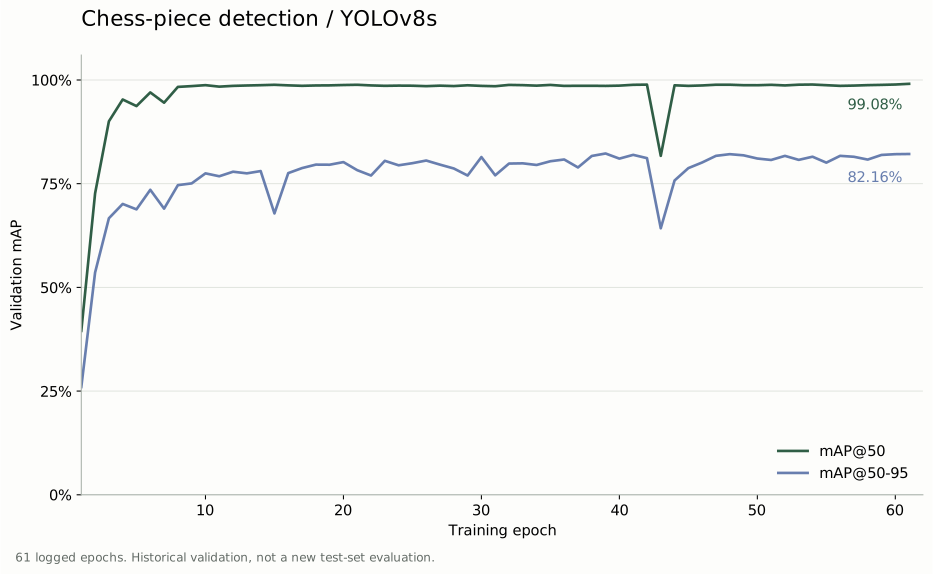
Historical validation
| Measure | Recorded result |
|---|---|
| Logged / configured epochs | 61 / 100 |
| Precision | 98.26% |
| Recall | 98.31% |
| mAP@50 | 99.08% |
| mAP@50-95 | 82.16% |
Training
I fine-tuned YOLOv8s on Roboflow-100’s chess-pieces dataset, version 2, using 640-pixel images and batch size 16. The saved run configuration records CPU training with checkpoint resume. The script targets 100 epochs; the retained log contains 61.
Recorded results
At epoch 61, validation precision was 98.26%, recall 98.31%, mAP@50 99.08%, and mAP@50–95 82.16%. The figure is generated directly from the committed training CSV. These are historical validation results, not a fresh held-out test or physical gameplay measurement.
The integration lesson
The dataset has 13 labels, including an ambiguous uncolored bishop. A chess board needs the 12 color-specific piece classes. A high detection score does not resolve that schema mismatch: uncertain labels must be rejected, relabeled, or retrained before board serialization.
Project history
The repository’s current version focuses on checkers with classical OpenCV perception. The training code and logs remain in the earlier chess revision linked below. The robot prototype footage belongs to the checkers work and is not evidence of this detector’s performance.